


Kythera AI
Advanced Flight Navigation AI
Full 3D navigation for drones, spaceships, and underwater creatures. An adaptive structure handles wide-open skies and tight, cluttered spaces in the same level. Clearance-aware movement lets characters of different sizes share the same space.
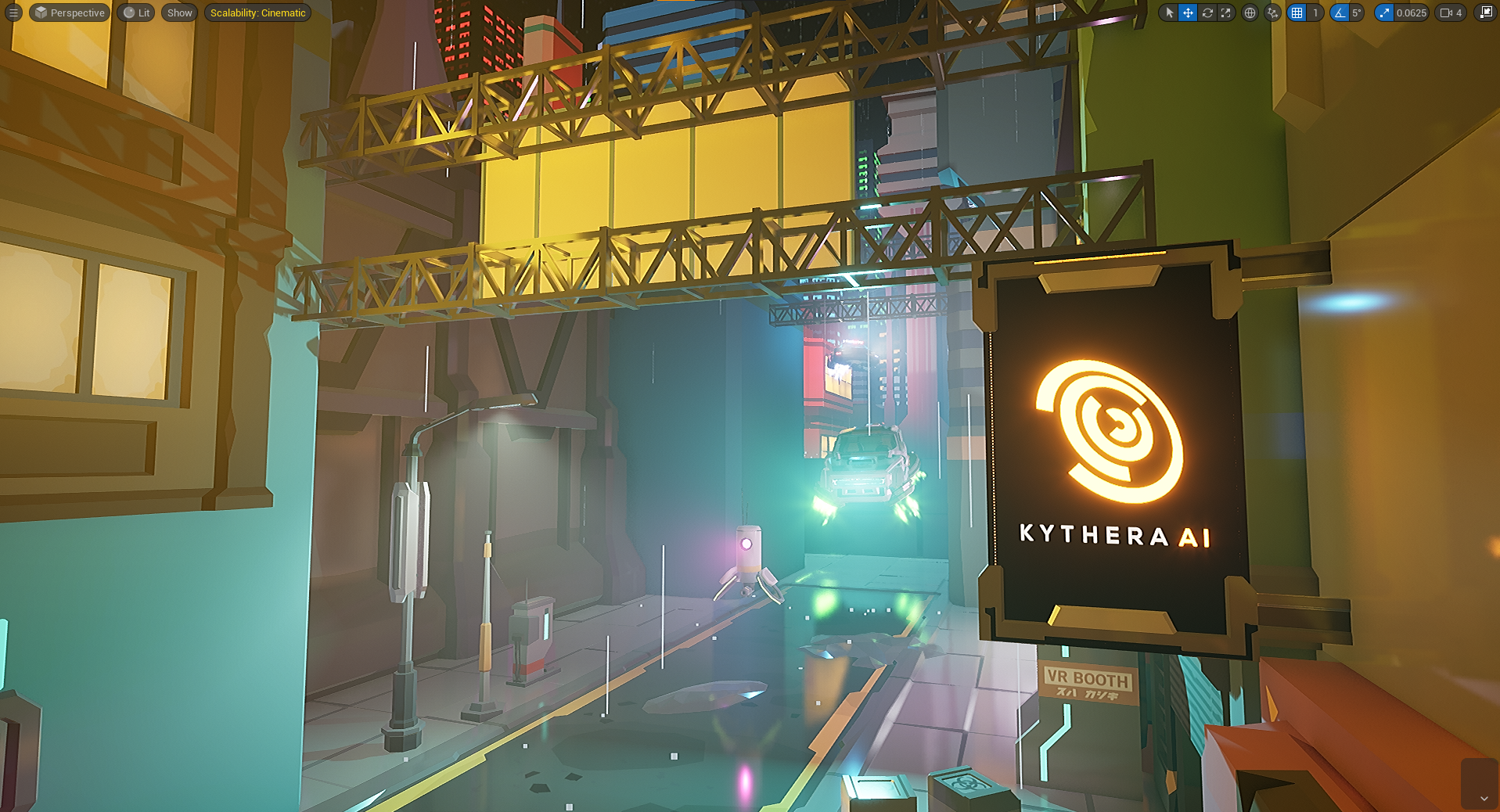
Navigation in three dimensions
Some NPCs move through open space rather than across a surface. A drone, a dragon, a spaceship, or an underwater creature has to account for the space above, below and around it, not only the ground. Kythera's Flight Navigation gives these NPCs a full three-dimensional picture of where they can move, so airborne and other free-moving NPCs navigate their surroundings as well as ground NPCs navigate terrain.
What Kythera’s Flight Navigation can do
Open skies and cluttered spaces
Kythera represents navigable space with an adaptive 3D structure that varies its detail to match the environment. Open airspace is stored coarsely and cheaply, while cluttered areas such as a built-up city, a hangar, or the gaps between structures are resolved in fine detail, down to the size of the character itself. A single level can cover both wide-open sky and tight, obstacle-filled spaces without storing all of it in fine detail. The memory it uses depends on how complex the environment is, not how large it is.
Clearance-aware movement
Kythera's 3D navigation records how much clearance exists at any point in space, not just whether a point is clear. A character can use that to judge whether it fits, keep a safe margin from obstacles, and move through confined spaces. Characters of different sizes can share the same environment, each one navigating according to its own dimensions.
Dynamic and extensible
The 3D navigable space can be regenerated as the world changes. Updates are streamed in over several frames instead of stalling the game, so the navigable volume keeps up with an evolving level. As with Kythera's ground navigation, the pipeline is extensible: you can add information such as cover, tactical markup, or your own custom data to the same structure. That lets 3D navigation support tactical airborne behavior, not only basic movement between two points.
Air, underwater, and zero gravity
The system works with navigable volume rather than a ground surface, so the same capability covers airborne, underwater, and zero-gravity characters alike. If your game spans more than one of these – flying creatures, submarines, spacecraft – you can use one navigation approach across all of them instead of a separate solution for each.
What this means for your game
Airborne, aquatic, and space-faring characters that move convincingly through 3D space, on top of a single navigation foundation that extends beyond the ground into the air, the water and beyond.